THE HUMAN SIDE OF DIVISION 5

When Shane Rendalls moved to the Southern Moreton Bay Islands, it was meant to be for retirement.

He and his wife came for a quieter life; a small farm, organic food, community involvement, part time consulting. He was serving as president of the local Chamber of Commerce and looking forward to something slower and simpler. Instead, he ran for council.

Today, as Division 5 councillor with the Redland City Council, Rendalls sits at the centre of the island community’s most pressing debates; infrastructure, growth, roads, parking, sewerage, bushfire risk. It’s not the retirement many would choose.

He traces the decision to throw his hat in the ring for the job back to frustration. Repeated attempts to navigate council processes on behalf of the islands left him feeling the southern end of Redlands wasn’t being advocated for strongly enough.

“I could see that the SMBI was maturing and needed financial help, yet it wasn’t happening fast enough to match the growth,” he says.

“I thought I should fight for the change I wanted from Council.”

A close friend questioned his sanity. Why swap a peaceful life for public office? Rendalls laughs at the memory now.

“Maybe I should’ve taken his advice,” he admits, particularly given the level of hostility he says he never expected at a local government level.

His platform was practical rather than political; get council to listen and work with the community, improve island roads and infrastructure, push for the long awaited multi-storey carpark, create jobs and protect the environment. Underpinning all of it was a simple belief; that no one person can change the future alone, but someone has to advocate.

What he didn’t anticipate was how deeply the role would seep into family life. “It’s a constant 24/7 job,” he says.

“If you’re not out talking to people or looking at problems in the community, you’re thinking about them.”

Recently, his grandson delivered a line that cut through; “You’re always on the phone, Poppy.”

Council meetings and community issues don’t clock off at five. Budget season, in particular, stretches patience thin.

“Nothing replaces being present,” he says, especially when island issues risk being overshadowed by broader city wide challenges.

The workload itself doesn’t intimidate him. With a background leading complex projects across health, housing, disability and child protection, he finds the research, planning and negotiation familiar territory.

“The job is easy for me,” he says candidly.

“But the preparation and analysis for each council meeting can be exhausting.”

What has surprised him most isn’t the complexity, it’s the tone.

“On a positive level, the support from strangers who appreciate what you’re doing has been heartening,” he says.

“Seeing the significant difference small changes for the islands can make in people’s lives, reminds you why the work matters.”

But there’s another side. What has taken Rendalls most by surprise is the level of hate from people he’s never met. Some of it, he notes, doesn’t even come from within Division 5.

He’s been described as having thick skin, yet online abuse and threats aren’t theoretical.

“Death threats are a real concern and a worry to both me and my family,” he says quietly.

His children worry about his safety. His wife keeps a low profile to avoid controversy. Friends have urged him to walk away. There are moments when he questions the cost.

“It is costing time with family,” he says.

“I do wonder if the grief this causes me and my family is really worth the effort. The money is certainly not worth the angst.”

Still, he remains and part of what drives him is a desire to demystify how council actually works. Residents often ask why something can’t simply be fixed or funded immediately. He understands the frustration, he often shares it.

“There is not a magic money tree to solve our island problems, every major spend is distributed across ratepayers citywide, and the islands represent only a small share of the total electorate,” he says.

“Policy and legislation tightly restrict what councillors can do and they are not permitted to direct Council staff to carry out specific tasks.”

It’s this web of constraints that makes some decisions appear baffling from the outside. He cites the Macleay Island Community Centre - a project tied to pre-existing grant funding - as one that sat uncomfortably with him.

“It naturally questions what competing priorities this funding could’ve been better spent on,” he says.

“But the reality is, if not spent on the community centre, the money would not necessarily be re-allocated to SMBI and the State grant would have to be returned.”

“It’s that process of trying to make decisions across high competing priorities that is the hardest.”

What keeps him awake at night is not political rivalry, but risk; bushfires in a growing island population with limited escape routes and patchy mobile coverage, and sewerage infrastructure he has described as a ticking environmental time bomb.

Yet he rejects the idea that he’s become disconnected from everyday life.

“No chance,” he says.

He meets residents at the shops, on ferries, at community events. The role, in many ways, has immersed him more deeply in island life than retirement ever would have.

Away from the chamber, he is a man who works his farm to clear his head and talks to his goats - “we can butt heads without taking offence.” He loves music, theatre and friends. He believes “everybody should be given a chance to succeed and be their best.”

Ask him about pride, and his answer is immediate and personal; watching his youngest daughter get her driver’s licence; seeing each of his children carve out their own path. Those are the moments that matter. Yet inevitably, the conversation returns to the islands.

In 10 or 20 years, he hopes they remain a place where people can breathe clean air, find meaningful work and feel proud to call home. A community that watches out for each other.

“Please, be considerate and watch out for each other,” he says.

“A simple hi, a smile and a wave can make all the difference to a person’s day; nobody should be made to feel less.”

Behind the debates and the decisions is not a headline or a voting card, but a man who came here to slow down. And chose instead to stand up. Not because it was easy, but because he felt the islands were worth fighting for.

So the next time Rendalls’ name appears in a comment thread or a heated debate about the islands’ future, it’s worth remembering that behind the title is just one person navigating decisions that affect thousands, doing his best to balance the needs of a community he cares about.

Mar 25, 2026

6 min read

LOCAL LEGENDS

For the second month of Local Legends, I’ve asked the same set of questions to another island legend. Every community has them. The people who quietly get on with things, lending their time, talent and energy to the groups and organisations that keep a place thriving. They rarely seek the spotlight, but without them, a lot of the good things simply wouldn’t happen. This time it’s Allan (Al) Prestwood in the spotlight.

Many islanders will know Al through music. He plays with the Redlands Wind Ensemble, Redlands Big Band, SMBI Community Band, and Jazz+, a small combo that brings a lively mix of jazz standards and favourites to local audiences.

But his contribution to island life goes well beyond the stage. Al also volunteers with SMBI Coastcare and several Russell Island community groups, including Whistling Kite Bushcare, the SMBI Museum, and the St Peter’s Church Op Shop. In other words, if something good is happening around the islands, there’s a fair chance Al has had a hand in it.

Here are Al’s answers to the questions, sharing his thoughts, stories, and island insights:

When and why did you come to the SMB Islands?

Looking for a sea change in 2003 with mangroves, small community, essential services and preferably close to Brisbane. Russell Island ticked all the boxes.

What are you known for here?

Probably either volunteering, environmental projects, picking up litter on a pushie, or music.

What have the islands changed about you that you didn’t consent to?

Odd question. The only thing I can think of is developing a dislike of solid 2m high fences.

It was never a consideration before, when the island was open. The siloing of houses with tall fencing is a constant reminder of the change from island community to suburb.

What part of yourself only exists because of the islands?

That's easy. Environmental awareness and appreciation of the beauty of our different ecosystems; exposure to diverse musical genres and the opportunity to play in four groups; and an interest in local history (shout-out to the SMBI museum).

What’s the strangest advice you’ve ever followed?

Don't count your winnings before the correct weight announcement (don't anticipate outcomes).

What’s a mistake you’re glad you made?

Getting lost in the bush on Russell and discovering hidden gems.

What small thing gives you the most joy here?

Volunteering and meeting other volunteers. It's personally rewarding and some of the happiest people I meet are volunteers.


Mar 25, 2026

2 min read

WHERE’S GERARD?

Through the pages of The Friendly Bay Islander, he quietly documented island life; the characters, milestones, triumphs, and tragedies. Yet for a man who spent decades telling other people’s stories, Gerard rarely told his own.

Which is why, since he quietly stepped away from the magazine five months ago, a question has been floating around the islands with surprising frequency. Where’s Gerard?

For a man who spent a lifetime asking the questions, answering them feels unusual.

“I rarely talk or write about myself,” he says. But Gerard’s story is worth telling.

For over sixty years, he worked across Australia and Papua New Guinea, owning and running newspapers and publications long before arriving on the islands to slow down. Gerard and his wife Glenda had just settled on Macleay Island when a local publication attempt fizzled out. With decades of publishing experience behind him, he put his retirement plans on hold and decided to start one himself.

The first issue of The Friendly Bay Islander was just 16 pages. But the community embraced it quickly, and local advertisers jumped onboard, recognising that islanders were starved for information and that this publication would be their lifeline. Within a short time, it grew to 40 pages, then 60, and sometimes as many as 80. For a small cluster of islands, it was remarkable. More importantly, Gerard had a purpose behind the pages.

“When we first came here the islands had a shocking reputation,” he says. “They were often written off as a sleepy backwater.”

Rather than feed the negativity that often drives news headlines, Gerard chose a different approach; tell positive stories about local people.

“In most people’s lives they get a birth notice when they’re born and a death notice when they die, and there’s no recognition in between,” he says.

So he went looking for the stories in between, and discovered the islands were full of them.

War veterans with incredible histories, colourful characters, volunteers, artists, and everyday residents who had quietly lived extraordinary lives. Slowly, the magazine helped shift how people saw the islands, and how islanders saw themselves.

Elissa, his daughter, has been by his side for most of it.

“She started helping me when she was 12, sorting photos and assisting with layouts,” Gerard says.

“She literally grew up in the pages of the magazine, and seeing her take over completely is one of the proudest moments of my life.”

Gerard also used the publication to campaign on issues affecting the community, including the push that eventually led to free inter-island ferry travel, something he believes changed the way the islands connected.

Now, the man who spent fifteen years documenting island life is enjoying something new; slowing the pace. These days, Gerard can usually be found working on the waterfront home he designed with Glenda, where the water sits just ten metres from the back verandah. Once it’s finished, the plan is simple; sit on the deck, enjoy the view, go for a daily walk, and maybe take a swim straight out the front.

“I’m looking forward to completely relaxing,” he says.

He admits he misses the interaction with the community, but slowing down hasn’t made him invisible. Islanders still stop for a chat, wave from passing cars, or call out across the street.

This year Gerard turns 80, and his ambitions for the next chapter are refreshingly simple; family, watching his eleven grandchildren grow, and enjoying the simple life.

Journalism wasn’t Gerard’s first claim to fame. Before the newspapers, he was a professional runner and still holds the record for winning the most professional “Gift” races in Australian history - thirteen in total.

When asked what he hopes the legacy of The Friendly Bay Islander will be, his answer is characteristically humble.

“I hope it made a bit of a difference,” he said, spoken with the quiet understatement of a man who once made a habit of finishing first.

Because in Gerard Thompson’s view, the Southern Moreton Bay Islands were always something special.

“The islands are the jewel in the crown of the Redlands; they just weren’t recognised,” he said.

Gerard now trades deadlines for deck chairs, newspapers for hammer and timber, and stories for daily swims. The familiar shouts of “Hey Gerard!” still make him smile. After a lifetime telling other people’s stories, he’s finally living his own; quietly, contentedly, and with that trademark mischief intact.

Mar 25, 2026

4 min read

THE HUMAN SIDE OF DIVISION 5

When Shane Rendalls moved to the Southern Moreton Bay Islands, it was meant to be for retirement.

He and his wife came for a quieter life; a small farm, organic food, community involvement, part time consulting. He was serving as president of the local Chamber of Commerce and looking forward to something slower and simpler. Instead, he ran for council.

Today, as Division 5 councillor with the Redland City Council, Rendalls sits at the centre of the island community’s most pressing debates; infrastructure, growth, roads, parking, sewerage, bushfire risk. It’s not the retirement many would choose.

He traces the decision to throw his hat in the ring for the job back to frustration. Repeated attempts to navigate council processes on behalf of the islands left him feeling the southern end of Redlands wasn’t being advocated for strongly enough.

“I could see that the SMBI was maturing and needed financial help, yet it wasn’t happening fast enough to match the growth,” he says.

“I thought I should fight for the change I wanted from Council.”

A close friend questioned his sanity. Why swap a peaceful life for public office? Rendalls laughs at the memory now.

“Maybe I should’ve taken his advice,” he admits, particularly given the level of hostility he says he never expected at a local government level.

His platform was practical rather than political; get council to listen and work with the community, improve island roads and infrastructure, push for the long awaited multi-storey carpark, create jobs and protect the environment. Underpinning all of it was a simple belief; that no one person can change the future alone, but someone has to advocate.

What he didn’t anticipate was how deeply the role would seep into family life. “It’s a constant 24/7 job,” he says.

“If you’re not out talking to people or looking at problems in the community, you’re thinking about them.”

Recently, his grandson delivered a line that cut through; “You’re always on the phone, Poppy.”

Council meetings and community issues don’t clock off at five. Budget season, in particular, stretches patience thin.

“Nothing replaces being present,” he says, especially when island issues risk being overshadowed by broader city wide challenges.

The workload itself doesn’t intimidate him. With a background leading complex projects across health, housing, disability and child protection, he finds the research, planning and negotiation familiar territory.

“The job is easy for me,” he says candidly.

“But the preparation and analysis for each council meeting can be exhausting.”

What has surprised him most isn’t the complexity, it’s the tone.

“On a positive level, the support from strangers who appreciate what you’re doing has been heartening,” he says.

“Seeing the significant difference small changes for the islands can make in people’s lives, reminds you why the work matters.”

But there’s another side. What has taken Rendalls most by surprise is the level of hate from people he’s never met. Some of it, he notes, doesn’t even come from within Division 5.

He’s been described as having thick skin, yet online abuse and threats aren’t theoretical.

“Death threats are a real concern and a worry to both me and my family,” he says quietly.

His children worry about his safety. His wife keeps a low profile to avoid controversy. Friends have urged him to walk away. There are moments when he questions the cost.

“It is costing time with family,” he says.

“I do wonder if the grief this causes me and my family is really worth the effort. The money is certainly not worth the angst.”

Still, he remains and part of what drives him is a desire to demystify how council actually works. Residents often ask why something can’t simply be fixed or funded immediately. He understands the frustration, he often shares it.

“There is not a magic money tree to solve our island problems, every major spend is distributed across ratepayers citywide, and the islands represent only a small share of the total electorate,” he says.

“Policy and legislation tightly restrict what councillors can do and they are not permitted to direct Council staff to carry out specific tasks.”

It’s this web of constraints that makes some decisions appear baffling from the outside. He cites the Macleay Island Community Centre - a project tied to pre-existing grant funding - as one that sat uncomfortably with him.

“It naturally questions what competing priorities this funding could’ve been better spent on,” he says.

“But the reality is, if not spent on the community centre, the money would not necessarily be re-allocated to SMBI and the State grant would have to be returned.”

“It’s that process of trying to make decisions across high competing priorities that is the hardest.”

What keeps him awake at night is not political rivalry, but risk; bushfires in a growing island population with limited escape routes and patchy mobile coverage, and sewerage infrastructure he has described as a ticking environmental time bomb.

Yet he rejects the idea that he’s become disconnected from everyday life.

“No chance,” he says.

He meets residents at the shops, on ferries, at community events. The role, in many ways, has immersed him more deeply in island life than retirement ever would have.

Away from the chamber, he is a man who works his farm to clear his head and talks to his goats - “we can butt heads without taking offence.” He loves music, theatre and friends. He believes “everybody should be given a chance to succeed and be their best.”

Ask him about pride, and his answer is immediate and personal; watching his youngest daughter get her driver’s licence; seeing each of his children carve out their own path. Those are the moments that matter. Yet inevitably, the conversation returns to the islands.

In 10 or 20 years, he hopes they remain a place where people can breathe clean air, find meaningful work and feel proud to call home. A community that watches out for each other.

“Please, be considerate and watch out for each other,” he says.

“A simple hi, a smile and a wave can make all the difference to a person’s day; nobody should be made to feel less.”

Behind the debates and the decisions is not a headline or a voting card, but a man who came here to slow down. And chose instead to stand up. Not because it was easy, but because he felt the islands were worth fighting for.

So the next time Rendalls’ name appears in a comment thread or a heated debate about the islands’ future, it’s worth remembering that behind the title is just one person navigating decisions that affect thousands, doing his best to balance the needs of a community he cares about.

LOCAL LEGENDS

For the second month of Local Legends, I’ve asked the same set of questions to another island legend. Every community has them. The people who quietly get on with things, lending their time, talent and energy to the groups and organisations that keep a place thriving. They rarely seek the spotlight, but without them, a lot of the good things simply wouldn’t happen. This time it’s Allan (Al) Prestwood in the spotlight.

Many islanders will know Al through music. He plays with the Redlands Wind Ensemble, Redlands Big Band, SMBI Community Band, and Jazz+, a small combo that brings a lively mix of jazz standards and favourites to local audiences.

But his contribution to island life goes well beyond the stage. Al also volunteers with SMBI Coastcare and several Russell Island community groups, including Whistling Kite Bushcare, the SMBI Museum, and the St Peter’s Church Op Shop. In other words, if something good is happening around the islands, there’s a fair chance Al has had a hand in it.

Here are Al’s answers to the questions, sharing his thoughts, stories, and island insights:

When and why did you come to the SMB Islands?

Looking for a sea change in 2003 with mangroves, small community, essential services and preferably close to Brisbane. Russell Island ticked all the boxes.

What are you known for here?

Probably either volunteering, environmental projects, picking up litter on a pushie, or music.

What have the islands changed about you that you didn’t consent to?

Odd question. The only thing I can think of is developing a dislike of solid 2m high fences.

It was never a consideration before, when the island was open. The siloing of houses with tall fencing is a constant reminder of the change from island community to suburb.

What part of yourself only exists because of the islands?

That's easy. Environmental awareness and appreciation of the beauty of our different ecosystems; exposure to diverse musical genres and the opportunity to play in four groups; and an interest in local history (shout-out to the SMBI museum).

What’s the strangest advice you’ve ever followed?

Don't count your winnings before the correct weight announcement (don't anticipate outcomes).

What’s a mistake you’re glad you made?

Getting lost in the bush on Russell and discovering hidden gems.

What small thing gives you the most joy here?

Volunteering and meeting other volunteers. It's personally rewarding and some of the happiest people I meet are volunteers.


WHERE’S GERARD?

Through the pages of The Friendly Bay Islander, he quietly documented island life; the characters, milestones, triumphs, and tragedies. Yet for a man who spent decades telling other people’s stories, Gerard rarely told his own.

Which is why, since he quietly stepped away from the magazine five months ago, a question has been floating around the islands with surprising frequency. Where’s Gerard?

For a man who spent a lifetime asking the questions, answering them feels unusual.

“I rarely talk or write about myself,” he says. But Gerard’s story is worth telling.

For over sixty years, he worked across Australia and Papua New Guinea, owning and running newspapers and publications long before arriving on the islands to slow down. Gerard and his wife Glenda had just settled on Macleay Island when a local publication attempt fizzled out. With decades of publishing experience behind him, he put his retirement plans on hold and decided to start one himself.

The first issue of The Friendly Bay Islander was just 16 pages. But the community embraced it quickly, and local advertisers jumped onboard, recognising that islanders were starved for information and that this publication would be their lifeline. Within a short time, it grew to 40 pages, then 60, and sometimes as many as 80. For a small cluster of islands, it was remarkable. More importantly, Gerard had a purpose behind the pages.

“When we first came here the islands had a shocking reputation,” he says. “They were often written off as a sleepy backwater.”

Rather than feed the negativity that often drives news headlines, Gerard chose a different approach; tell positive stories about local people.

“In most people’s lives they get a birth notice when they’re born and a death notice when they die, and there’s no recognition in between,” he says.

So he went looking for the stories in between, and discovered the islands were full of them.

War veterans with incredible histories, colourful characters, volunteers, artists, and everyday residents who had quietly lived extraordinary lives. Slowly, the magazine helped shift how people saw the islands, and how islanders saw themselves.

Elissa, his daughter, has been by his side for most of it.

“She started helping me when she was 12, sorting photos and assisting with layouts,” Gerard says.

“She literally grew up in the pages of the magazine, and seeing her take over completely is one of the proudest moments of my life.”

Gerard also used the publication to campaign on issues affecting the community, including the push that eventually led to free inter-island ferry travel, something he believes changed the way the islands connected.

Now, the man who spent fifteen years documenting island life is enjoying something new; slowing the pace. These days, Gerard can usually be found working on the waterfront home he designed with Glenda, where the water sits just ten metres from the back verandah. Once it’s finished, the plan is simple; sit on the deck, enjoy the view, go for a daily walk, and maybe take a swim straight out the front.

“I’m looking forward to completely relaxing,” he says.

He admits he misses the interaction with the community, but slowing down hasn’t made him invisible. Islanders still stop for a chat, wave from passing cars, or call out across the street.

This year Gerard turns 80, and his ambitions for the next chapter are refreshingly simple; family, watching his eleven grandchildren grow, and enjoying the simple life.

Journalism wasn’t Gerard’s first claim to fame. Before the newspapers, he was a professional runner and still holds the record for winning the most professional “Gift” races in Australian history - thirteen in total.

When asked what he hopes the legacy of The Friendly Bay Islander will be, his answer is characteristically humble.

“I hope it made a bit of a difference,” he said, spoken with the quiet understatement of a man who once made a habit of finishing first.

Because in Gerard Thompson’s view, the Southern Moreton Bay Islands were always something special.

“The islands are the jewel in the crown of the Redlands; they just weren’t recognised,” he said.

Gerard now trades deadlines for deck chairs, newspapers for hammer and timber, and stories for daily swims. The familiar shouts of “Hey Gerard!” still make him smile. After a lifetime telling other people’s stories, he’s finally living his own; quietly, contentedly, and with that trademark mischief intact.

THE HUMAN SIDE OF DIVISION 5

When Shane Rendalls moved to the Southern Moreton Bay Islands, it was meant to be for retirement.

He and his wife came for a quieter life; a small farm, organic food, community involvement, part time consulting. He was serving as president of the local Chamber of Commerce and looking forward to something slower and simpler. Instead, he ran for council.

Today, as Division 5 councillor with the Redland City Council, Rendalls sits at the centre of the island community’s most pressing debates; infrastructure, growth, roads, parking, sewerage, bushfire risk. It’s not the retirement many would choose.

He traces the decision to throw his hat in the ring for the job back to frustration. Repeated attempts to navigate council processes on behalf of the islands left him feeling the southern end of Redlands wasn’t being advocated for strongly enough.

“I could see that the SMBI was maturing and needed financial help, yet it wasn’t happening fast enough to match the growth,” he says.

“I thought I should fight for the change I wanted from Council.”

A close friend questioned his sanity. Why swap a peaceful life for public office? Rendalls laughs at the memory now.

“Maybe I should’ve taken his advice,” he admits, particularly given the level of hostility he says he never expected at a local government level.

His platform was practical rather than political; get council to listen and work with the community, improve island roads and infrastructure, push for the long awaited multi-storey carpark, create jobs and protect the environment. Underpinning all of it was a simple belief; that no one person can change the future alone, but someone has to advocate.

What he didn’t anticipate was how deeply the role would seep into family life. “It’s a constant 24/7 job,” he says.

“If you’re not out talking to people or looking at problems in the community, you’re thinking about them.”

Recently, his grandson delivered a line that cut through; “You’re always on the phone, Poppy.”

Council meetings and community issues don’t clock off at five. Budget season, in particular, stretches patience thin.

“Nothing replaces being present,” he says, especially when island issues risk being overshadowed by broader city wide challenges.

The workload itself doesn’t intimidate him. With a background leading complex projects across health, housing, disability and child protection, he finds the research, planning and negotiation familiar territory.

“The job is easy for me,” he says candidly.

“But the preparation and analysis for each council meeting can be exhausting.”

What has surprised him most isn’t the complexity, it’s the tone.

“On a positive level, the support from strangers who appreciate what you’re doing has been heartening,” he says.

“Seeing the significant difference small changes for the islands can make in people’s lives, reminds you why the work matters.”

But there’s another side. What has taken Rendalls most by surprise is the level of hate from people he’s never met. Some of it, he notes, doesn’t even come from within Division 5.

He’s been described as having thick skin, yet online abuse and threats aren’t theoretical.

“Death threats are a real concern and a worry to both me and my family,” he says quietly.

His children worry about his safety. His wife keeps a low profile to avoid controversy. Friends have urged him to walk away. There are moments when he questions the cost.

“It is costing time with family,” he says.

“I do wonder if the grief this causes me and my family is really worth the effort. The money is certainly not worth the angst.”

Still, he remains and part of what drives him is a desire to demystify how council actually works. Residents often ask why something can’t simply be fixed or funded immediately. He understands the frustration, he often shares it.

“There is not a magic money tree to solve our island problems, every major spend is distributed across ratepayers citywide, and the islands represent only a small share of the total electorate,” he says.

“Policy and legislation tightly restrict what councillors can do and they are not permitted to direct Council staff to carry out specific tasks.”

It’s this web of constraints that makes some decisions appear baffling from the outside. He cites the Macleay Island Community Centre - a project tied to pre-existing grant funding - as one that sat uncomfortably with him.

“It naturally questions what competing priorities this funding could’ve been better spent on,” he says.

“But the reality is, if not spent on the community centre, the money would not necessarily be re-allocated to SMBI and the State grant would have to be returned.”

“It’s that process of trying to make decisions across high competing priorities that is the hardest.”

What keeps him awake at night is not political rivalry, but risk; bushfires in a growing island population with limited escape routes and patchy mobile coverage, and sewerage infrastructure he has described as a ticking environmental time bomb.

Yet he rejects the idea that he’s become disconnected from everyday life.

“No chance,” he says.

He meets residents at the shops, on ferries, at community events. The role, in many ways, has immersed him more deeply in island life than retirement ever would have.

Away from the chamber, he is a man who works his farm to clear his head and talks to his goats - “we can butt heads without taking offence.” He loves music, theatre and friends. He believes “everybody should be given a chance to succeed and be their best.”

Ask him about pride, and his answer is immediate and personal; watching his youngest daughter get her driver’s licence; seeing each of his children carve out their own path. Those are the moments that matter. Yet inevitably, the conversation returns to the islands.

In 10 or 20 years, he hopes they remain a place where people can breathe clean air, find meaningful work and feel proud to call home. A community that watches out for each other.

“Please, be considerate and watch out for each other,” he says.

“A simple hi, a smile and a wave can make all the difference to a person’s day; nobody should be made to feel less.”

Behind the debates and the decisions is not a headline or a voting card, but a man who came here to slow down. And chose instead to stand up. Not because it was easy, but because he felt the islands were worth fighting for.

So the next time Rendalls’ name appears in a comment thread or a heated debate about the islands’ future, it’s worth remembering that behind the title is just one person navigating decisions that affect thousands, doing his best to balance the needs of a community he cares about.

LOCAL LEGENDS

For the second month of Local Legends, I’ve asked the same set of questions to another island legend. Every community has them. The people who quietly get on with things, lending their time, talent and energy to the groups and organisations that keep a place thriving. They rarely seek the spotlight, but without them, a lot of the good things simply wouldn’t happen. This time it’s Allan (Al) Prestwood in the spotlight.

Many islanders will know Al through music. He plays with the Redlands Wind Ensemble, Redlands Big Band, SMBI Community Band, and Jazz+, a small combo that brings a lively mix of jazz standards and favourites to local audiences.

But his contribution to island life goes well beyond the stage. Al also volunteers with SMBI Coastcare and several Russell Island community groups, including Whistling Kite Bushcare, the SMBI Museum, and the St Peter’s Church Op Shop. In other words, if something good is happening around the islands, there’s a fair chance Al has had a hand in it.

Here are Al’s answers to the questions, sharing his thoughts, stories, and island insights:

When and why did you come to the SMB Islands?

Looking for a sea change in 2003 with mangroves, small community, essential services and preferably close to Brisbane. Russell Island ticked all the boxes.

What are you known for here?

Probably either volunteering, environmental projects, picking up litter on a pushie, or music.

What have the islands changed about you that you didn’t consent to?

Odd question. The only thing I can think of is developing a dislike of solid 2m high fences.

It was never a consideration before, when the island was open. The siloing of houses with tall fencing is a constant reminder of the change from island community to suburb.

What part of yourself only exists because of the islands?

That's easy. Environmental awareness and appreciation of the beauty of our different ecosystems; exposure to diverse musical genres and the opportunity to play in four groups; and an interest in local history (shout-out to the SMBI museum).

What’s the strangest advice you’ve ever followed?

Don't count your winnings before the correct weight announcement (don't anticipate outcomes).

What’s a mistake you’re glad you made?

Getting lost in the bush on Russell and discovering hidden gems.

What small thing gives you the most joy here?

Volunteering and meeting other volunteers. It's personally rewarding and some of the happiest people I meet are volunteers.


WHERE’S GERARD?

Through the pages of The Friendly Bay Islander, he quietly documented island life; the characters, milestones, triumphs, and tragedies. Yet for a man who spent decades telling other people’s stories, Gerard rarely told his own.

Which is why, since he quietly stepped away from the magazine five months ago, a question has been floating around the islands with surprising frequency. Where’s Gerard?

For a man who spent a lifetime asking the questions, answering them feels unusual.

“I rarely talk or write about myself,” he says. But Gerard’s story is worth telling.

For over sixty years, he worked across Australia and Papua New Guinea, owning and running newspapers and publications long before arriving on the islands to slow down. Gerard and his wife Glenda had just settled on Macleay Island when a local publication attempt fizzled out. With decades of publishing experience behind him, he put his retirement plans on hold and decided to start one himself.

The first issue of The Friendly Bay Islander was just 16 pages. But the community embraced it quickly, and local advertisers jumped onboard, recognising that islanders were starved for information and that this publication would be their lifeline. Within a short time, it grew to 40 pages, then 60, and sometimes as many as 80. For a small cluster of islands, it was remarkable. More importantly, Gerard had a purpose behind the pages.

“When we first came here the islands had a shocking reputation,” he says. “They were often written off as a sleepy backwater.”

Rather than feed the negativity that often drives news headlines, Gerard chose a different approach; tell positive stories about local people.

“In most people’s lives they get a birth notice when they’re born and a death notice when they die, and there’s no recognition in between,” he says.

So he went looking for the stories in between, and discovered the islands were full of them.

War veterans with incredible histories, colourful characters, volunteers, artists, and everyday residents who had quietly lived extraordinary lives. Slowly, the magazine helped shift how people saw the islands, and how islanders saw themselves.

Elissa, his daughter, has been by his side for most of it.

“She started helping me when she was 12, sorting photos and assisting with layouts,” Gerard says.

“She literally grew up in the pages of the magazine, and seeing her take over completely is one of the proudest moments of my life.”

Gerard also used the publication to campaign on issues affecting the community, including the push that eventually led to free inter-island ferry travel, something he believes changed the way the islands connected.

Now, the man who spent fifteen years documenting island life is enjoying something new; slowing the pace. These days, Gerard can usually be found working on the waterfront home he designed with Glenda, where the water sits just ten metres from the back verandah. Once it’s finished, the plan is simple; sit on the deck, enjoy the view, go for a daily walk, and maybe take a swim straight out the front.

“I’m looking forward to completely relaxing,” he says.

He admits he misses the interaction with the community, but slowing down hasn’t made him invisible. Islanders still stop for a chat, wave from passing cars, or call out across the street.

This year Gerard turns 80, and his ambitions for the next chapter are refreshingly simple; family, watching his eleven grandchildren grow, and enjoying the simple life.

Journalism wasn’t Gerard’s first claim to fame. Before the newspapers, he was a professional runner and still holds the record for winning the most professional “Gift” races in Australian history - thirteen in total.

When asked what he hopes the legacy of The Friendly Bay Islander will be, his answer is characteristically humble.

“I hope it made a bit of a difference,” he said, spoken with the quiet understatement of a man who once made a habit of finishing first.

Because in Gerard Thompson’s view, the Southern Moreton Bay Islands were always something special.

“The islands are the jewel in the crown of the Redlands; they just weren’t recognised,” he said.

Gerard now trades deadlines for deck chairs, newspapers for hammer and timber, and stories for daily swims. The familiar shouts of “Hey Gerard!” still make him smile. After a lifetime telling other people’s stories, he’s finally living his own; quietly, contentedly, and with that trademark mischief intact.

THE LITTLE LAUNDRY THAT REFUSED TO FADE AWAY

Local resident William "Bill" Marshall has been keeping an eye on an old workshop and laundry shed from the 1930s. Built by local cabinet maker and

shopfitter Jimmy Gibson, this is no ordinary shed.

"He built it like a piece of furniture, no shortcuts, no flimsy

weatherboards," Bill says.

"Every joint is tight, every bit of timber solid; you can tell he meant for it to last."

The timber? Cypress pine sawn right here on the island. Nearly a hundred years later, the little workshop/laundry still stands, a testament to Gibson's craftsmanship. The building's asbestos cladding has been removed and it's now being prepared for relocation. But a new home is needed for the shed to survive.

Bill and other locals have a dream; to turn it into a small museum or community space where Macleay Island history can be shared.

"I'm dreaming out loud and hope we can share the vision," Bill says.

"There are lots of places, like the RSL, that don't have a meeting spot and this could be it!"

The response from the community has been overwhelmingly positive. Bill has offered some of his own old building items, including leadlight doors, to help make it happen. From the original demolition, a petrol driven washing machine was saved and is now held by Don Scott, who grew up on the island.

"My mother got one of these when I was a kid, and she thought she had died and gone to heaven," he recalls.

Nearly a century later, this little shed and its stories may have a new lease on life thanks to community care and determination.

For anyone interested in learning more, getting involved, or helping relocate the shed, contact Bill on 0418 111 784.

STEAMBOAT KEN’S GREAT YARNS OF BOATS & MARITIME HISTORY SMOKESTACKS IN THE MANGROVES

FELLOW islanders, whilst travelling to the mainland during the cane crushing season (June-Dec), one notices to the south a smoke stack that appears to be in the mangroves.

It’s the Rocky Point sugar mill at Woongoolba.

Years ago when my son Lance was younger and we were out in our steamboat, I’d say to him ‘There’s another steamboat over there, hiding in the mangroves’.

But it’s Heck’s sugar mill, one of the oldest in Queensland and the only mill privately-owned.

It’s been owned by five generations of the same family since 1879, when German immigrant Carl Heinrich Heck founded the mill.

The mill’s annual crushing has gone from 400 to 40,000 tonnes of cane.

It’s very swampy country, and the German wagons had trouble on the wet ground. The Heck’s put in a rail line in 1920 and bought an English locomotive built by John Fowler & Co, Leeds, West Yorkshire. They had about 100 cane trucks for the loco to pull. The line went out to Norwell, with a branch to Jacobs Well. The old loco is in the Beenleigh Historical Village.

As motor trucks became common after WW11, the line was used less, closing in 1951. I know when I came to the district about 50 years ago, the line was ripped up but the full cane rail trucks were still shunted into the mill with a tractor. Each cane farm had a short length of line. The rail trucks were winched onto motor trucks to get to the mill.

The Hecks ran a butcher shop for the mill workers, plus accommodation. There was quite a village around the mill.

There used to be 40 mills in the district, albeit small. But as transport improved they gradually closed, with Rocky Point the last mill still working. The remnants of the mill at Ageston can be seen from the Logan River at Ageston Sands. The brick footings for the steam engine are still extant.

The engine in my steamboat LOUISA came from a sugar mill.

A trip down through the cane fields is a good day’s run. The road passes right beside the mill, and if it’s crushing season there’s steam wafting about and lots of noise and activity.

There’s a couple of old Queensland pubs to slake one’s thirst after their travels.

So there we have it. It’s not a steamboat in the mangroves, but it’s a whole different world away from Redland Bay and district. Check it out one day.

Cheers

Steamboat Ken

FROM BARE FEET TO BEST FOOT FORWARD - AN ISLAND EXHIBITION WITH STYLE

Island life has a rhythm. Bare feet. Faded hats. Comfort first, always. So when three Macleay Island artists ask their community to dress to impress, it’s not about pretension, it’s about celebration.

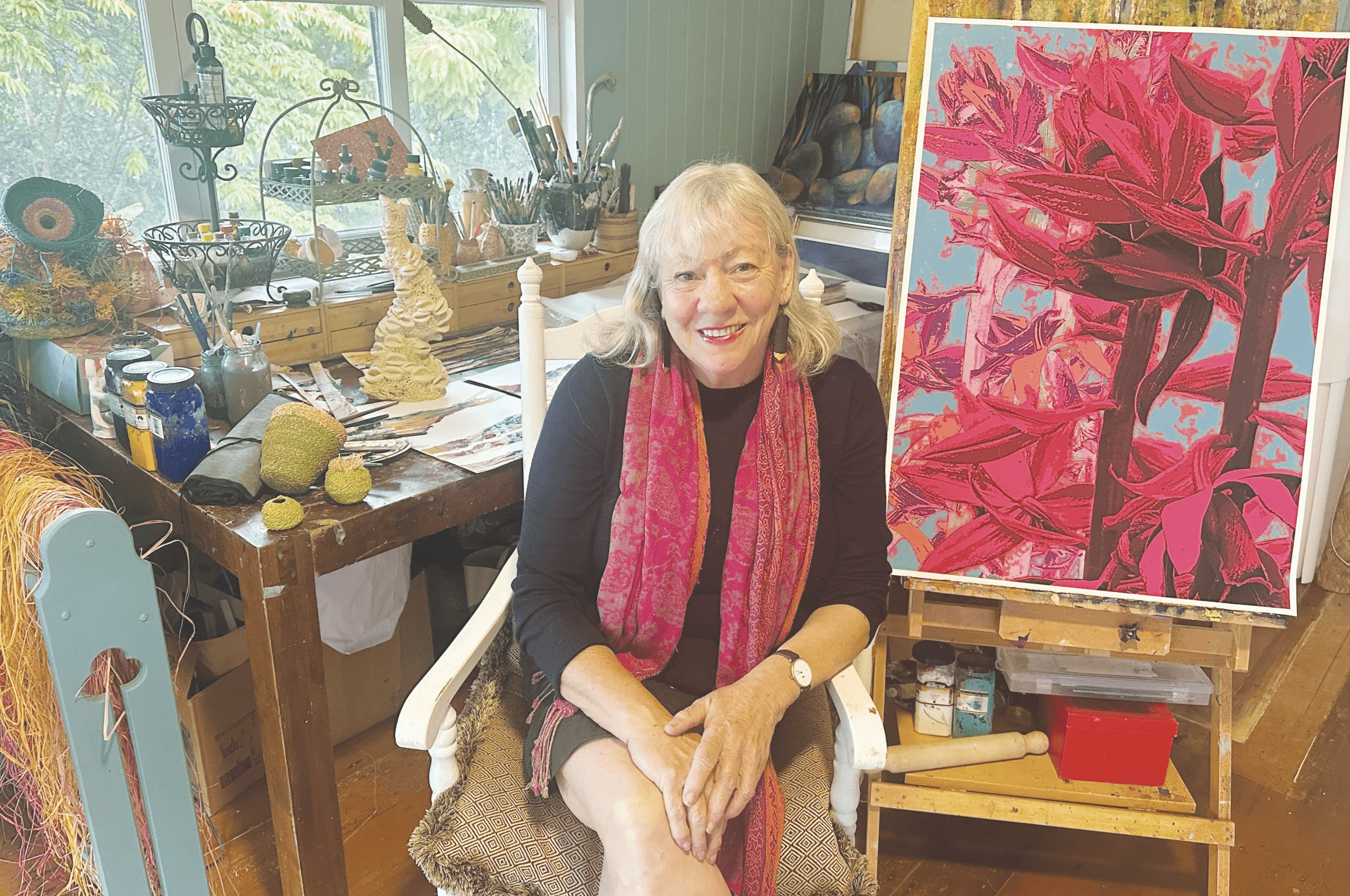
Two Painters and a Potter, opening 24 April at the Macleay Island Arts Complex (MIAC), is part exhibition, part love letter to the island, and part gentle challenge - step out of the comfort zone, raise a glass, and mark the moment.

The artists; Therese King, Beth Leach and Paula Bowie; didn’t arrive on Macleay Island at the same time, but they all arrived at a turning point. Between them, they’ve spent more than a decade living here; Therese four years, Paula five, Beth buying land in 2020, when the islands quietly absorbed thousands of newcomers searching for space, safety and something slower. What they found was not just a place to live, but a place to change.

Their work reflects that shift. This is art made from gardens, mangroves, rocks, cuttings gifted by friends; the kind you wrap in damp paper and carry home like contraband treasure.

“The botany we paint is often from our own gardens, or our friends’ gardens,” Beth says.

“There’s something special about that, it’s friendship made physical.”

Therese paints abstract botanicals in acrylic, work that moves between colour and emotion. After decades teaching art, including at the Flying Fruit Fly Circus School, she finally turned the focus inward.

“Coming to the islands, I’ve just blossomed,” she says.

“People here respond emotionally to art and that’s been huge for my confidence.”

For potter Paula, that same sense of intimacy with place is embedded in clay. Her stoneware vessels pay homage to ancient forms, drawing inspiration from Macleay Island’s organic textures; eroded edges, shifting surfaces and muted, natural palettes.

“I’m always responding to the landscape here,” Paula says.

“The way the environment feels both delicate and unpredictable, that all ends up in the work.”

Beth’s paintings hold time. A nationally award winning botanical illustrator, Beth came to oil painting after illness forced a recalibration of her life. Formerly working in watercolour, she now paints large scale, realistic botanicals.

“I’ve had a lot of different careers and art came back when I needed healing,” Beth says.

Together, the three artists form a quiet triangle of support. When one of them hits a creative wall, the other two step in, offering perspective, encouragement and practical advice that helps the work move forward again. It’s the kind of creative safety net every artist needs, and one they’ve found in each other.

That mutual energy is visible in the exhibition itself. The paintings and pottery don’t compete, they converse. Nothing feels accidental.

And then there’s the opening night. The official opening at MIAC on Thursday 24 April, from 6.00pm to 8.30pm, asks guests to do something slightly radical by island standards.

“Art deserves an occasion and we want everyone to dress to impress,” Beth says.

Like the island itself, this exhibition is about connection; between materials, landscapes and three women who found each other exactly when they needed to.

Two Painters and a Potter runs from 24 April to 18 May. Entry is free.

Opening night tickets are limited and priced at $35, which includes a welcome drink and finger food. It’s a chance to celebrate local creativity, share conversation and just this once, swap the thongs for your best foot forward.

Advertise with
the Friendly
Bay Islander

Advertise with
the Friendly
Bay Islander

Advertise with
the Friendly
Bay Islander

This isn’t just a website—it’s your gateway to targeting the Bay Islands and surrounding Redlands Area.
A culturally significant public artwork, installed on North Stradbroke Island (Minjerribah) in 2019, was recently repaired by Redland City Council after sustaining damage over time.The work, Mirriginpah – Sea Eagle Law at Cabarita Park, Amity (Pulan Pulan), features an eagle soaring over a school of three dolphins.The artwork and place marker by Quandamooka artist Belinda Close symbolised the cultural importance of Mirriginpah (the sea eagle) to the Quandamooka People.This story provides a unique insight into a connection between people and place that extends more than 21,000 years.Unfortunately, the work had sustained damage to the noses of three dolphins and one fin since its installation in December 2019.It has now been expertly repaired, ready to be enjoyed by the community during National Reconciliation Week (27 May to 3 June) and beyond, ensuring this beautiful representation of Quandamooka culture and history will continue to be a memorable attraction for visitors to the island.“National Reconciliation Week is an opportunity for everyone to explore the rich Indigenous history on Redlands Coast and, in keeping with this year’s theme of ‘Bridging Now to Next’, to look ahead and use past lessons to guide us forward.”Division 2 Councillor Peter Mitchell said the innovative repairs to the sculpture were undertaken by the public art consultants who were engaged in the original planning and delivery of the work.“I am pleased this stunning artwork has been restored and will continue to promote awareness of Quandamooka Country on Redlands Coast.”

A culturally significant public artwork, installed on North Stradbroke Island (Minjerribah) in 2019, was recently repaired by Redland City Council after sustaining damage over time.The work, Mirriginpah – Sea Eagle Law at Cabarita Park, Amity (Pulan Pulan), features an eagle soaring over a school of three dolphins.The artwork and place marker by Quandamooka artist Belinda Close symbolised the cultural importance of Mirriginpah (the sea eagle) to the Quandamooka People.This story provides a unique insight into a connection between people and place that extends more than 21,000 years.Unfortunately, the work had sustained damage to the noses of three dolphins and one fin since its installation in December 2019.It has now been expertly repaired, ready to be enjoyed by the community during National Reconciliation Week (27 May to 3 June) and beyond, ensuring this beautiful representation of Quandamooka culture and history will continue to be a memorable attraction for visitors to the island.“National Reconciliation Week is an opportunity for everyone to explore the rich Indigenous history on Redlands Coast and, in keeping with this year’s theme of ‘Bridging Now to Next’, to look ahead and use past lessons to guide us forward.”Division 2 Councillor Peter Mitchell said the innovative repairs to the sculpture were undertaken by the public art consultants who were engaged in the original planning and delivery of the work.“I am pleased this stunning artwork has been restored and will continue to promote awareness of Quandamooka Country on Redlands Coast.”

A culturally significant public artwork, installed on North Stradbroke Island (Minjerribah) in 2019, was recently repaired by Redland City Council after sustaining damage over time.The work, Mirriginpah – Sea Eagle Law at Cabarita Park, Amity (Pulan Pulan), features an eagle soaring over a school of three dolphins.The artwork and place marker by Quandamooka artist Belinda Close symbolised the cultural importance of Mirriginpah (the sea eagle) to the Quandamooka People.This story provides a unique insight into a connection between people and place that extends more than 21,000 years.Unfortunately, the work had sustained damage to the noses of three dolphins and one fin since its installation in December 2019.It has now been expertly repaired, ready to be enjoyed by the community during National Reconciliation Week (27 May to 3 June) and beyond, ensuring this beautiful representation of Quandamooka culture and history will continue to be a memorable attraction for visitors to the island.“National Reconciliation Week is an opportunity for everyone to explore the rich Indigenous history on Redlands Coast and, in keeping with this year’s theme of ‘Bridging Now to Next’, to look ahead and use past lessons to guide us forward.”Division 2 Councillor Peter Mitchell said the innovative repairs to the sculpture were undertaken by the public art consultants who were engaged in the original planning and delivery of the work.“I am pleased this stunning artwork has been restored and will continue to promote awareness of Quandamooka Country on Redlands Coast.”