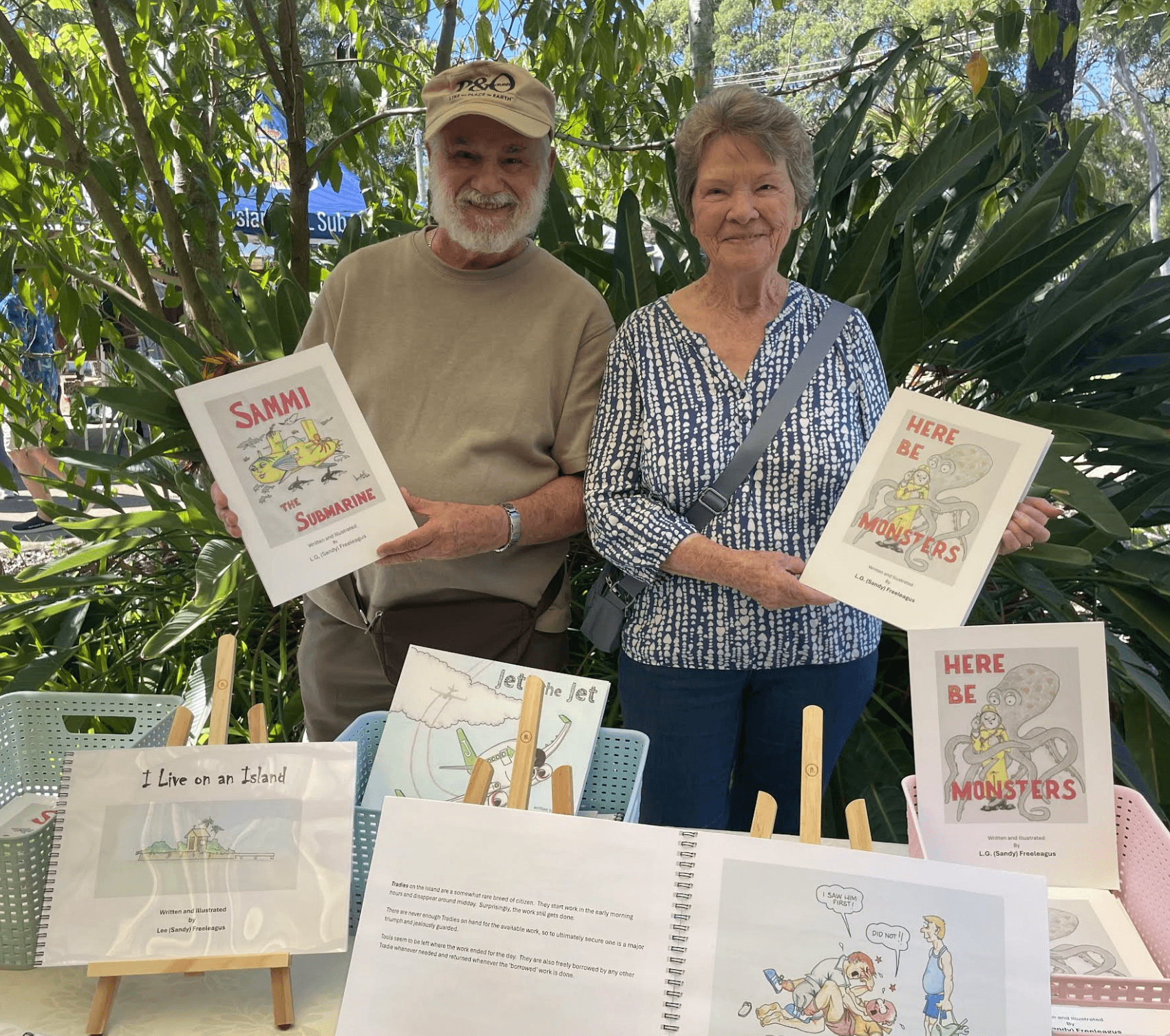
It’s a habit that’s followed him everywhere - from high school classrooms to Navy submarines - and one that, at one point, got his work banned by a senior officer for hitting a little too close to the mark.
“I still kept drawing for myself,” he says. “I think I did some of my best work then.”
That instinct to observe, reinterpret and gently disrupt has been with him from the beginning.
It started in a German language class, where a series of cartoons introduced an unlikely First World War fighter ace; Wolfgang Fritz der Grosser. Someone laughed. That was enough. The direction was set.
“I’ve cartooned for many, many years,” Sandy says, almost offhand, as though it’s something that simply runs in the background of life rather than something he chose. And, as it turns out, it’s something that would shape far more than just his career.
As a 19 year old naval apprentice, Sandy attended a debutant ball where apprentices were paired with nurses from Auburn District Hospital; same uniforms, attendance required, all very formal. But the night didn’t go to plan.
Robyn, then a 17 year old nurse, wasn’t his assigned partner, but she noticed him. Later, she invited Sandy and her official partner back to her sister and brother-in-law’s flat.
“I won her by drawing little pictures all night,” Sandy says, admitting he was largely unaware of her feelings at the time.
Life soon pulled them apart; Robyn to Sydney, Sandy to Melbourne; but the connection held, growing into a long distance romance. On just their third one on one meeting, and on Robyn’s 18th birthday, he asked her to marry him. Fifty-eight years later, they’re still side by side - proof that sometimes the smallest sketches leave the longest marks.
Over time, that same instinct that won him a wife found its way into institutions. During his Navy years, Sandy contributed cartoons to Navy News, later moving into work with the Defence Academy, illustrating everything from writing procedures to the unlikely mechanics of a full stop. Bureaucracy, routine and officialdom became fertile ground; always handled with a sharp eye and a quiet sense of humour.
“In this silly world of ours, you have to laugh - if not at ourselves, then the government is always a good subject,” he said.
These days, the setting has changed. Sandy first came to Macleay Island alongside his son, who was buying land. Like many who arrive without intending to stay, he found himself drawn in. The view did the rest. Now living on an absolute waterfront, the pace has shifted.
“Work is calmer here,” he says. “I can take longer and put just that little bit more effort into it.”
But while the surroundings are slower, the ideas are not. His process remains instinctive; less about searching for inspiration and more about recognising it when it appears. A passing moment, a memory, a fragment of conversation. Often the idea arrives fully formed, as if it’s been waiting.
Children’s books emerged in much the same way. Encouraged by friends long before he pursued them seriously, Sandy approached the format with the same philosophy: keep it simple, keep it honest, but always leave room for something extra.
There’s often a second layer tucked quietly into the page. A visual aside. A joke sitting just behind the main story. Something for the adult reading along, sharing the moment from a different angle.
Even island life has found its way into his work, though never at the expense of the people in it. Sandy avoids caricature, wary of exaggerating features in a way that might make someone feel exposed. Instead, he leans toward something softer; fictionalised echoes of real moments, handled, as he puts it, with “humorous respect.”
One story in his upcoming work Those Good Old Island Days captures that balance. It reflects on a well known local character - unnamed, but unmistakably remembered - preserving not a punchline, but a presence.
For someone who has spent a lifetime creating, recognition isn’t the goal.
“The accolades and fame,” he says. “Things like that embarrass me.”
What matters instead is the work itself. The making of it. The quiet satisfaction of bringing something into the world.
Alongside his cartoons and books, Sandy has also explored textured artworks using embroidery cotton, building layered, three dimensional pieces that reflect the same patience now afforded by island life.
There’s also a thread of memory running through much of what he creates; a fascination with how everyday life once looked and felt. Milk carts, ice deliveries, butcher’s paper instead of plastic. Not nostalgia for its own sake, but a way of holding onto details that might otherwise slip away.
It’s the same instinct that connects him back to the books he remembers from childhood, stories like Tootle and The Taxi That Hurried, which stayed with him long after the pages were closed. If his own work does the same for someone else, that’s enough.
And if it all disappeared tomorrow? He wouldn’t hesitate. He’d start again. Because for Sandy, drawing isn’t a career or a body of work to be measured. It’s simply a way of seeing; a way of finding something in the ordinary, and quietly turning it into something worth sharing.
Readers who would like to explore Sandy’s work or purchase his books can contact him directly at sandysworld@proton.me or visit www.sandysworld.com.au