When Shane Rendalls moved to the Southern Moreton Bay Islands, it was meant to be for retirement.
He and his wife came for a quieter life; a small farm, organic food, community involvement, part time consulting. He was serving as president of the local Chamber of Commerce and looking forward to something slower and simpler. Instead, he ran for council.
Today, as Division 5 councillor with the Redland City Council, Rendalls sits at the centre of the island community’s most pressing debates; infrastructure, growth, roads, parking, sewerage, bushfire risk. It’s not the retirement many would choose.
He traces the decision to throw his hat in the ring for the job back to frustration. Repeated attempts to navigate council processes on behalf of the islands left him feeling the southern end of Redlands wasn’t being advocated for strongly enough.
“I could see that the SMBI was maturing and needed financial help, yet it wasn’t happening fast enough to match the growth,” he says.
“I thought I should fight for the change I wanted from Council.”
A close friend questioned his sanity. Why swap a peaceful life for public office? Rendalls laughs at the memory now.
“Maybe I should’ve taken his advice,” he admits, particularly given the level of hostility he says he never expected at a local government level.
His platform was practical rather than political; get council to listen and work with the community, improve island roads and infrastructure, push for the long awaited multi-storey carpark, create jobs and protect the environment. Underpinning all of it was a simple belief; that no one person can change the future alone, but someone has to advocate.
What he didn’t anticipate was how deeply the role would seep into family life. “It’s a constant 24/7 job,” he says.
“If you’re not out talking to people or looking at problems in the community, you’re thinking about them.”
Recently, his grandson delivered a line that cut through; “You’re always on the phone, Poppy.”
Council meetings and community issues don’t clock off at five. Budget season, in particular, stretches patience thin.
“Nothing replaces being present,” he says, especially when island issues risk being overshadowed by broader city wide challenges.
The workload itself doesn’t intimidate him. With a background leading complex projects across health, housing, disability and child protection, he finds the research, planning and negotiation familiar territory.
“The job is easy for me,” he says candidly.
“But the preparation and analysis for each council meeting can be exhausting.”
What has surprised him most isn’t the complexity, it’s the tone.
“On a positive level, the support from strangers who appreciate what you’re doing has been heartening,” he says.
“Seeing the significant difference small changes for the islands can make in people’s lives, reminds you why the work matters.”
But there’s another side. What has taken Rendalls most by surprise is the level of hate from people he’s never met. Some of it, he notes, doesn’t even come from within Division 5.
He’s been described as having thick skin, yet online abuse and threats aren’t theoretical.
“Death threats are a real concern and a worry to both me and my family,” he says quietly.
His children worry about his safety. His wife keeps a low profile to avoid controversy. Friends have urged him to walk away. There are moments when he questions the cost.
“It is costing time with family,” he says.
“I do wonder if the grief this causes me and my family is really worth the effort. The money is certainly not worth the angst.”
Still, he remains and part of what drives him is a desire to demystify how council actually works. Residents often ask why something can’t simply be fixed or funded immediately. He understands the frustration, he often shares it.
“There is not a magic money tree to solve our island problems, every major spend is distributed across ratepayers citywide, and the islands represent only a small share of the total electorate,” he says.
“Policy and legislation tightly restrict what councillors can do and they are not permitted to direct Council staff to carry out specific tasks.”
It’s this web of constraints that makes some decisions appear baffling from the outside. He cites the Macleay Island Community Centre - a project tied to pre-existing grant funding - as one that sat uncomfortably with him.
“It naturally questions what competing priorities this funding could’ve been better spent on,” he says.
“But the reality is, if not spent on the community centre, the money would not necessarily be re-allocated to SMBI and the State grant would have to be returned.”
“It’s that process of trying to make decisions across high competing priorities that is the hardest.”
What keeps him awake at night is not political rivalry, but risk; bushfires in a growing island population with limited escape routes and patchy mobile coverage, and sewerage infrastructure he has described as a ticking environmental time bomb.
Yet he rejects the idea that he’s become disconnected from everyday life.
“No chance,” he says.
He meets residents at the shops, on ferries, at community events. The role, in many ways, has immersed him more deeply in island life than retirement ever would have.
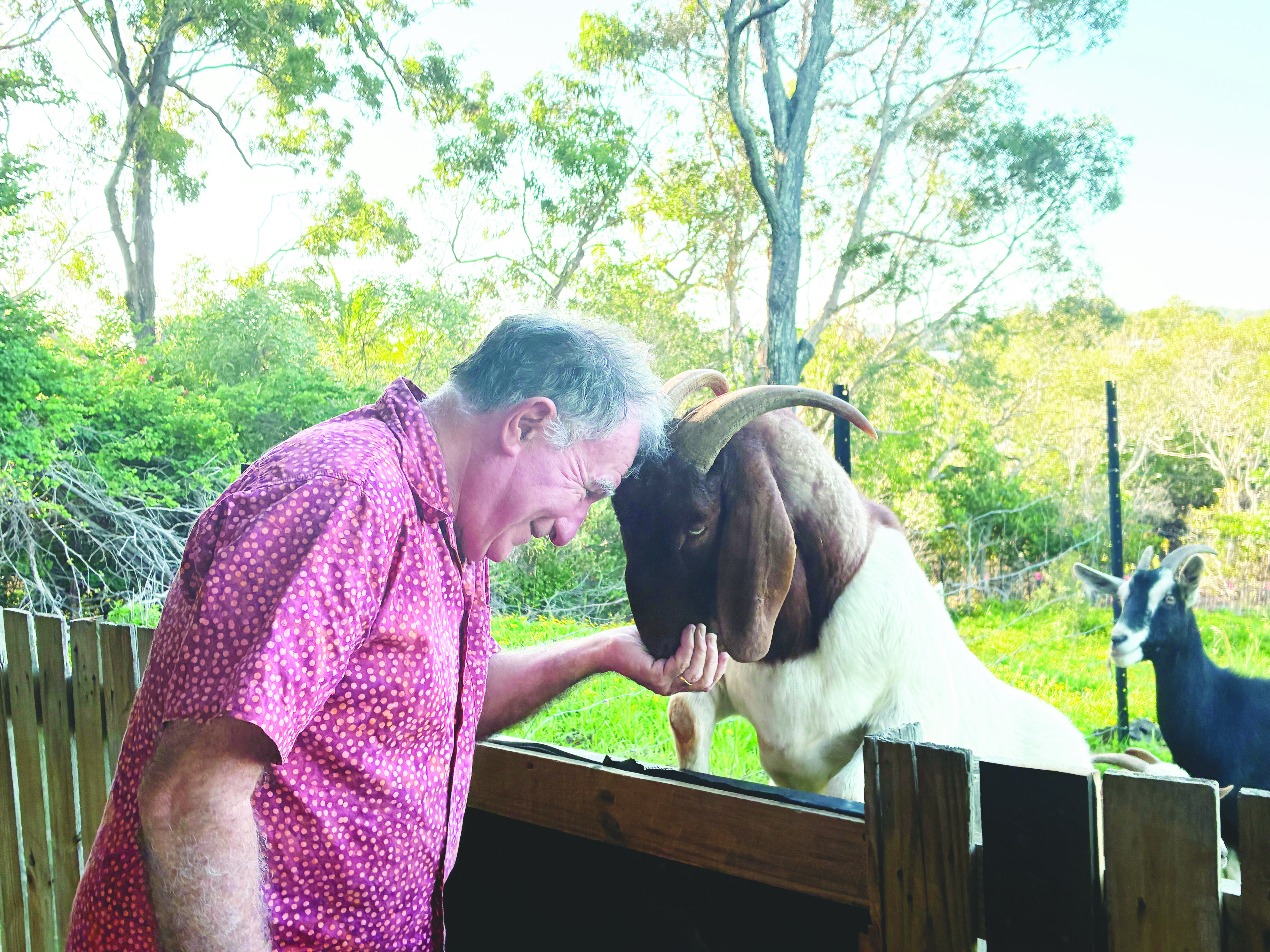
Away from the chamber, he is a man who works his farm to clear his head and talks to his goats - “we can butt heads without taking offence.” He loves music, theatre and friends. He believes “everybody should be given a chance to succeed and be their best.”
Ask him about pride, and his answer is immediate and personal; watching his youngest daughter get her driver’s licence; seeing each of his children carve out their own path. Those are the moments that matter. Yet inevitably, the conversation returns to the islands.
In 10 or 20 years, he hopes they remain a place where people can breathe clean air, find meaningful work and feel proud to call home. A community that watches out for each other.
“Please, be considerate and watch out for each other,” he says.
“A simple hi, a smile and a wave can make all the difference to a person’s day; nobody should be made to feel less.”
Behind the debates and the decisions is not a headline or a voting card, but a man who came here to slow down. And chose instead to stand up. Not because it was easy, but because he felt the islands were worth fighting for.
So the next time Rendalls’ name appears in a comment thread or a heated debate about the islands’ future, it’s worth remembering that behind the title is just one person navigating decisions that affect thousands, doing his best to balance the needs of a community he cares about.